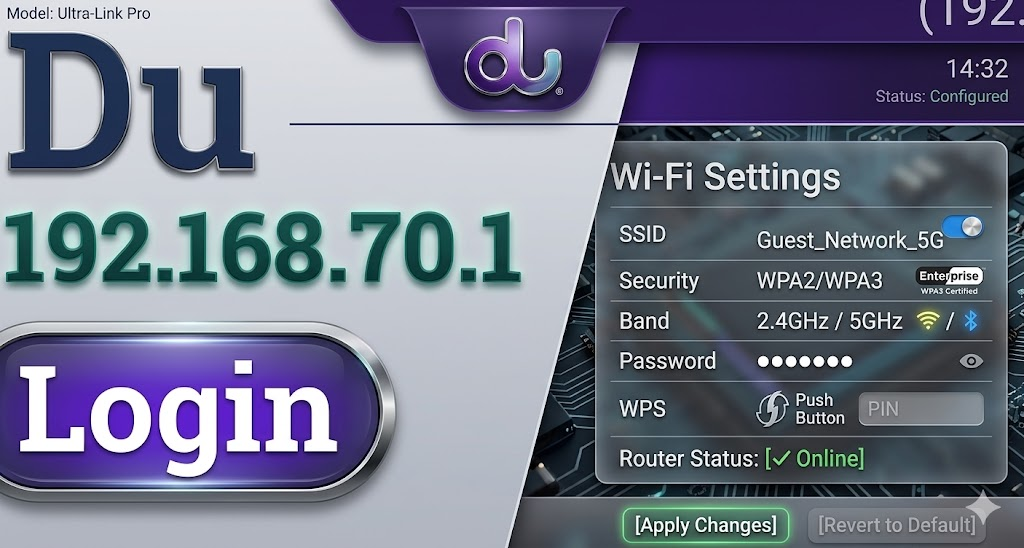
192.168.70.1 – Complete Du Router Login & Admin Guide for UAE Users
Private IP address, du router admin panel, default gateway, router login page, WiFi settings, ZLT router UAE, Emirates Integrated Telecommunications, router admin credentials, SSID configuration, network management UAE — these are the core concepts every du subscriber in the United Arab Emirates needs to understand before attempting to access their router’s control panel.
If you are a du customer in Dubai, Abu Dhabi, Sharjah, or anywhere else across the Emirates, there is a very high probability that 192.168.70.1 is the address you need to type into your browser to reach your router’s admin panel. This comprehensive guide covers everything from what this address actually is, why du routers in the UAE use it, how to log in correctly across different device models, how to change your WiFi name and password, how to fix every common error, how to secure your network, and how to perform a factory reset when all else fails. Whether you are a first-time router user or a small business owner managing a multi-device office network in Business Bay or JLT, this guide will give you full control over your connection.
What Is 192.168.70.1 and Why Does It Matter in the UAE?
To understand why 192.168.70.1 matters, you first need to understand what a private IP address is and how your home or office network is structured. Every router has two types of IP addresses: one that faces the public internet (your WAN address, assigned by your ISP) and one that faces your local network (your LAN address, also called the default gateway). The default gateway is the address your connected devices use to communicate with the router itself, and it is also the address you type into a browser to reach the router’s admin panel.
192.168.70.1 belongs to the private IPv4 address range defined by RFC 1918, specifically the 192.168.0.0/16 block. This means it is a Class C private address that can never be routed over the public internet. It only works within your local area network (LAN). You cannot reach it from a mobile data connection, you cannot access it from another building or city, and no one outside your local network can reach it either. This is by design — it keeps your router settings safe from external interference.
In the UAE, 192.168.70.1 has become particularly associated with du (Emirates Integrated Telecommunications Company), one of the country’s two major licensed telecommunications providers. Du distributes ZLT-manufactured routers — including popular models like the ZLT X21, ZLT S10, ZLT S12 Pro, and ZLT X28 5G — to its home broadband and wireless internet subscribers. These ZLT devices ship with 192.168.70.1 as the factory-set admin IP address. Because du is one of the most widely used ISPs across Dubai, Abu Dhabi, Sharjah, Ajman, Ras Al Khaimah, Fujairah, and Umm Al Quwain, this particular address has become one of the most searched router login IPs in the country.
It is important to note that not every du router uses this address. Du supplies different hardware models depending on the subscriber’s plan, location, and service type. Some du routers use 192.168.8.1 as their default gateway, while others use 192.168.1.1 or 192.168.0.1. The authoritative source for your specific router’s gateway address is always the sticker printed on the bottom or back of your device, or the default gateway shown on your connected phone or laptop. Never rely on memory or assume the address based on what you read online — always verify it directly.
Understanding the Du Router Ecosystem in the UAE
Du as an ISP and Its Router Distribution Model
Du, officially known as Emirates Integrated Telecommunications Company (EITC), was established in 2006 and has since grown to serve millions of residential and business customers across all seven emirates. As part of its internet service packages — which include 4G LTE home wireless, 5G home broadband, and fiber-backed wireless services — du supplies subscribers with preconfigured routers. These routers arrive with default settings that allow the subscriber to get online immediately without any manual configuration.
The routers du distributes are primarily manufactured by ZLT, a Chinese networking hardware company that specializes in 4G and 5G CPE (Customer Premises Equipment) devices. ZLT routers are designed with a web-based admin interface accessible via a local IP address, and for most models distributed in the UAE, that address is 192.168.70.1. Du typically applies its own firmware customization to these devices, which means the admin panel may look slightly different from the standard ZLT interface and may carry du branding.
Why ZLT and Du Chose 192.168.70.1
Most consumer routers worldwide use 192.168.1.1 or 192.168.0.1 as their default gateway. ZLT and du made a deliberate choice to use 192.168.70.1 instead, and this decision has a practical networking rationale. In apartments and office buildings across Dubai and other UAE cities, it is common for a router to be connected to another upstream network device — a modem, a building’s shared internet infrastructure, or a secondary router — that already uses 192.168.1.1. If the du router also used 192.168.1.1, a subnet conflict would arise, causing routing failures and connectivity problems. By using the less common 192.168.70.x subnet, ZLT and du reduce the likelihood of IP address conflicts in complex network environments. This makes it particularly practical for dense residential towers and commercial buildings in areas like Business Bay, Deira, Jumeirah Lake Towers (JLT), and Dubai Marina, where network infrastructure is often layered.
Du Router Models and Their Default Gateways
Because du uses multiple hardware models across its subscriber base, it is essential to know which gateway address corresponds to your specific router. The table below summarizes the most common du router models used in the UAE and their typical default gateways:
| Router Model | Type | Default Gateway |
|---|---|---|
| ZLT X21 (Du Home Wireless 5G) | 4G/5G CPE | 192.168.70.1 or 192.168.8.1 |
| ZLT S10 | 4G LTE CPE | 192.168.70.1 |
| ZLT S12 Pro | 4G/5G CPE | 192.168.70.1 |
| ZLT X28 5G | 5G CPE | 192.168.70.1 |
| D-Link DWR-M960 | 4G LTE Router | 192.168.0.1 |
| Nokia FastMile 5G Gateway | 5G Gateway | 192.168.1.1 |
Note: Firmware updates from du can change the default gateway on some models. Always trust the actual Default Gateway reported by your connected device over any printed or assumed value.
How to Find Your Router’s Actual Default Gateway
Before you attempt to open 192.168.70.1 in a browser, confirm that this is actually the gateway your router is currently using. This takes less than a minute and prevents the most common login failure.
On a Windows PC or Laptop
Open the Command Prompt by pressing the Windows key, typing “cmd,” and pressing Enter. Once the black command window appears, type the command ipconfig and press Enter. Look through the results for your active network adapter (Wi-Fi or Ethernet) and find the line labeled “Default Gateway.” The IP address shown there is the one your router is currently using. If it shows 192.168.70.1, proceed to the login steps. If it shows something else, use that address instead.
On a Mac
Click the Apple menu and open System Settings (or System Preferences on older macOS versions). Navigate to Network, select your active connection (Wi-Fi or Ethernet), and click Details or Advanced. Under the TCP/IP tab, you will see the Router field, which displays your default gateway.
On an iPhone or iPad
Open the Settings app and tap Wi-Fi. Find the network you are currently connected to and tap the small information icon next to its name. Scroll down to the Router field, which shows your gateway address.
On an Android Phone
The process varies slightly by device manufacturer, but generally: open Settings, go to Wi-Fi, tap on the network name, and look for Gateway or Router under the detailed connection information. Some Android devices require you to tap “Advanced” or view connection details to see this information.
On a Linux Desktop
Open a terminal and type the command ip route | grep default. The IP address shown after “default via” is your router’s default gateway.
If any of these methods shows an address other than 192.168.70.1, use that address for the login steps below. The gateway your device reports in real time always reflects the router’s actual live configuration.
Step-by-Step Login Guide for 192.168.70.1
Once you have confirmed that your router’s default gateway is 192.168.70.1, follow these steps to access the admin panel.
Step 1: Connect to Your Router’s Network
Your device must be connected to the same local network as the router. You can do this either wirelessly by connecting to the du Wi-Fi network, or via a physical Ethernet cable connected to one of the router’s LAN ports. Using an Ethernet cable is strongly recommended when making configuration changes, because if the Wi-Fi network restarts during a settings change, a wireless connection will drop and interrupt your session. A wired connection remains stable even when wireless settings are being modified.
Step 2: Open a Web Browser
Use any modern web browser such as Google Chrome, Mozilla Firefox, Microsoft Edge, or Safari. These browsers all handle local router admin pages correctly. Avoid using a browser extension or plugin that might intercept local IP addresses — some VPN browser extensions in particular can interfere with local network access.
Step 3: Type the Address Correctly in the Address Bar
This is where many users make a critical mistake. Click on the browser’s address bar — the long bar at the very top of the browser where website addresses are displayed. This is not the same as a search bar. Type exactly: http://192.168.70.1 and press Enter. Do not type it into Google Search or any other search engine. Do not add “www” before the address. Do not use spaces. Type only numbers and dots.
The most common typing error made by UAE users is entering 192.168.l.70.1 — using the lowercase letter “l” instead of the number “1.” Because many fonts display the lowercase letter “l” and the digit “1” very similarly, this mistake is easy to make and results in an invalid address that can never open a router page. IP addresses contain only digits (0 through 9) and decimal points — never letters. A second common error is adding an “s” to make https://192.168.70.1. Most du routers do not enforce HTTPS for their local admin panel, and attempting an HTTPS connection may trigger a browser security warning or fail to load entirely. Use http:// (without the “s”) unless you know your specific router model supports SSL. bin shabib mall
Step 4: Wait for the Login Page to Load
After pressing Enter, your browser will contact the router directly over your local network. Within a few seconds, a login page should appear. This page typically shows a username field, a password field, and a login button. The exact appearance varies by router model and firmware version.
Step 5: Enter Your Admin Username and Password
The default login credentials for ZLT and du routers are typically printed on a sticker attached to the back or bottom of the router. Common default combinations for du routers in the UAE include:
| Field | Common Default Value |
|---|---|
| Username | admin |
| Password | admin |
| Username | user |
| Password | (printed on sticker) |
| Username | admin |
| Password | (unique, printed on sticker) |
For many du-branded ZLT devices, the password is not a generic “admin” but a unique value printed on the device label. Always check the sticker before trying generic credentials. If credentials were previously changed and you cannot remember them, a factory reset is the only way to restore access.
Step 6: Explore the Admin Dashboard
After a successful login, the router’s dashboard will open. From here you can access all major settings including wireless configuration, connected device management, security settings, network diagnostics, firmware update tools, and advanced features like band locking and port forwarding. Take time to explore the interface before making changes, and always click Save or Apply after modifying any setting.
Changing Your WiFi Name (SSID) and Password
Once logged in to the admin panel via 192.168.70.1, changing your WiFi name and password is straightforward. These are among the most commonly requested changes by du subscribers across the UAE.
Changing the WiFi Name (SSID)
Navigate to the Wireless Settings or WiFi Settings section in the router dashboard. ZLT routers typically offer separate settings for the 2.4 GHz band and the 5 GHz band — dual-band configurations are common on models like the ZLT X21. Find the SSID field (this stands for Service Set Identifier and is simply your network’s broadcast name). Delete the current network name and type your desired new name. A good WiFi name should be easy for you to identify but should not include your apartment number, full name, or any other personally identifiable information that could be visible to neighbors. Click Save or Apply, and your router will briefly broadcast the new name. Reconnect your devices using the updated SSID.
Changing the WiFi Password
In the same Wireless Settings section, locate the field labeled Password, WiFi Password, WPA Key, or Pre-Shared Key depending on your router model. Delete the existing password and enter a new one. A strong WiFi password should be at least 12 characters long and include a combination of uppercase letters, lowercase letters, numbers, and symbols. Avoid using your phone number, apartment number, or any sequence of consecutive numbers or letters. Select WPA2-PSK as your security protocol, or WPA3 if your router supports it. Avoid WEP entirely — it is an outdated and easily broken security standard. After saving the new password, all currently connected devices will be disconnected and will need to reconnect using the new credentials.
Managing Connected Devices
One of the most useful features accessible through 192.168.70.1 is the connected devices panel. This section, sometimes labeled “Device List,” “Connected Clients,” or “DHCP Client List,” shows every device currently connected to your router — along with each device’s IP address, MAC address, and often its hostname or device name.
This feature is particularly valuable in the UAE context, where apartment buildings and villas often host multiple residents or family members, and unauthorized device connections are a genuine concern. Regularly reviewing your connected devices list helps you identify any unfamiliar devices that may have connected without your permission. If you see a device you do not recognize, you can often block its MAC address directly from the admin panel, effectively preventing it from reconnecting to your network even if it knows your password.
In dense urban areas of Dubai and Sharjah especially, neighbors may sometimes see your network name broadcast. A strong password combined with MAC address filtering provides a much more robust defense than a password alone.
Advanced Features Available Through the Admin Panel
Band Management and Channel Selection
In areas with high WiFi density — apartment buildings in Downtown Dubai, Deira, or Al Barsha, for example — wireless interference from neighboring networks is a significant and common problem. When many networks compete for the same wireless channels, all of them experience degraded performance. Through the 192.168.70.1 admin panel, you can manually select which wireless channel your router broadcasts on, moving away from the congested channels and improving your connection speed and stability.
For 2.4 GHz networks, channels 1, 6, and 11 are the non-overlapping options most often recommended. For 5 GHz networks, there are more available channels with less interference. ZLT routers also support auto channel selection, where the router scans the environment and picks the least congested option automatically — a useful setting for environments where neighbor networks change frequently.
Band Locking (5G/4G LTE)
ZLT routers used by du in the UAE support a feature called band locking, accessible under Network Settings or Advanced Settings in the admin panel. Band locking allows you to force the router to connect to a specific LTE or 5G frequency band. This is valuable because du’s network operates across multiple frequency bands, and the router may not always automatically select the band that delivers the best performance in your specific location. By testing different bands and locking onto the strongest one, subscribers in signal-variable locations across the UAE can achieve meaningfully faster and more stable speeds.
DHCP Configuration
The DHCP (Dynamic Host Configuration Protocol) server in your router is responsible for automatically assigning IP addresses to devices when they connect to your network. Through the admin panel, you can view the DHCP lease table, modify the range of addresses assigned, set DHCP reservations (so that a specific device always receives the same IP address), and adjust the lease duration. For UAE home users running smart home devices, security cameras, or NAS drives, DHCP reservations are particularly useful because they ensure these devices always have a predictable local address.
Port Forwarding
Port forwarding is a feature used to allow external internet connections to reach a specific device inside your local network. Common use cases in UAE home and small office environments include hosting a game server, enabling remote desktop access, configuring a security camera system for remote viewing, and running a local file server accessible from outside the building. Port forwarding rules are configured in the admin panel and require you to specify the incoming port number, protocol (TCP, UDP, or both), and the local IP address of the target device.
Firmware Updates
ZLT routers distributed by du receive periodic firmware updates that fix security vulnerabilities, improve stability, and sometimes add new features. Firmware update options are typically found under the System or Administration section of the admin panel accessible at 192.168.70.1. Before applying a firmware update, it is strongly recommended to export or note your current configuration settings, as some firmware upgrades reset certain parameters to default. Never disconnect the router from power during a firmware update, as this can corrupt the firmware and render the device non-functional.
Troubleshooting: Why 192.168.70.1 Is Not Working
If the login page does not open when you type 192.168.70.1 into your browser, one of several issues is likely responsible. Below is a systematic approach to diagnosing and fixing every common problem du users in the UAE encounter.
Problem 1: Wrong Address (Letter vs. Number Confusion)
The single most common reason UAE users cannot access their router admin page is a typing error. If you have typed 192.168.l.70.1 (with a lowercase letter “l” instead of the digit “1”), the address is invalid and will never open a router page. Similarly, addresses containing uppercase “O” instead of zero, or any other letter substitution, will fail. Double-check every character carefully before pressing Enter.
Problem 2: Your Router Actually Uses a Different Gateway
Even if 192.168.70.1 is widely associated with du routers, your specific device may use a different address. Check your Default Gateway using the device-specific steps described earlier in this guide. If your gateway is 192.168.8.1, 192.168.1.1, or 192.168.0.1, use that address instead.
Problem 3: Device Not Connected to the Router
You must be connected to the router’s local network — either via Wi-Fi or an Ethernet cable — to access its admin panel. If you are browsing on mobile data, the address will not work. Switch to the router’s Wi-Fi connection and try again.
Problem 4: VPN or Proxy Interference
A VPN (Virtual Private Network) application running on your device can prevent access to local network resources including your router admin panel. VPNs route all your traffic through a remote server, making your device unable to communicate with local IP addresses like 192.168.70.1. Disable your VPN completely before attempting to open the router admin page.
Problem 5: Browser Cache or Extension Conflicts
Occasionally, browser extensions — particularly ad blockers, privacy tools, or security plugins — can interfere with loading local IP addresses. Try opening the admin page in a private or incognito browsing window, which disables most extensions. Alternatively, try a different browser entirely. If the page opens in one browser but not another, a browser-level issue is responsible.
Problem 6: Router Needs a Restart
If the router has been running for an extended period without a restart, or if it has experienced a minor software fault, its web interface may become temporarily inaccessible. Power off the router by pressing the power button or unplugging it, wait 10 to 15 seconds, then power it back on. Allow 60 to 90 seconds for the router to fully boot and stabilize before attempting to access the admin panel again.
Problem 7: HTTPS vs. HTTP
Some users add an “s” to the protocol prefix and type https://192.168.70.1 instead of http://192.168.70.1. Most ZLT and du routers do not use HTTPS for their local admin interface. Attempting an HTTPS connection will often produce a browser security warning or a connection error. Remove the “s” and use plain HTTP.
Problem 8: Address Typed Into Search Bar Instead of Address Bar
Modern browsers have a combined address and search bar, and typing an IP address that looks unusual into a search engine will redirect you to Google or Bing search results rather than the router’s admin page. Make sure you are clicking directly on the address bar at the very top of the browser (where the current website’s URL is shown), not in any search field within a webpage.
How to Perform a Factory Reset on Du ZLT Routers
A factory reset returns the router to its original default settings, restoring the default gateway address, default admin credentials, and default WiFi name and password. This is necessary when you have forgotten the admin password and cannot log in, when the router is behaving abnormally, or when you want to start the configuration from scratch.
Factory Reset Procedure for ZLT Routers (Including ZLT X21, S10, S12 Pro, X28 5G)
First, ensure the router is fully powered on and all indicator LEDs are stable — do not attempt a reset while the router is booting. Locate the Reset button on the back or bottom of the device. On ZLT routers distributed by du in the UAE, this button is typically recessed into a small hole and requires a pin, paperclip, or SIM ejector tool to press. Press and hold the Reset button for 10 seconds. You will see the indicator lights flash or change pattern, signaling that the reset process has begun. Release the button and allow the router to reboot completely — this typically takes 60 to 90 seconds. Once the LEDs stabilize, the router has returned to its factory default state. The default WiFi name and password will revert to the values printed on the router’s sticker. Connect to the default WiFi network and open your browser to access 192.168.70.1 with the default admin credentials, which for most ZLT devices are “admin” for both username and password (verify on your device sticker).
Important note for UAE du subscribers: After a factory reset, you may need to reconfigure your internet connection settings if du requires specific APN settings or connection parameters for your service plan. Contact du’s customer support if your internet does not work after a factory reset, even though your local admin panel is accessible.
Security Best Practices for Du Router Users in the UAE
Accessing your router admin panel and keeping it secure is not just a technical task — in the UAE’s densely populated urban environment, where apartment towers house dozens of interconnected households, router security is a genuine practical concern. The following best practices are recommended for all du subscribers using any admin panel address including 192.168.70.1.
Change the Default Admin Password Immediately
Many ZLT routers distributed by du in the UAE use “admin” as both the default username and password. This is one of the most widely known default credential combinations in the networking world. Anyone connected to your local network — including building WiFi infrastructure or a neighbor who has guessed your WiFi password — could potentially access your router settings if the admin password remains at its default. Change it to a strong, unique password as soon as you gain access to the admin panel, and store it in a secure password manager.
Use WPA2-PSK or WPA3 Encryption
When configuring your wireless network through the admin panel, always select WPA2-PSK or WPA3 as the security protocol. WPA3 is the most modern and secure option and is supported on newer ZLT models including the X28 5G. WPA2-PSK provides strong security for older devices. Avoid WEP and WPA (first generation) entirely — these protocols are outdated and can be cracked in minutes with widely available tools.
Disable Remote Management
Some routers offer a “remote management” feature that allows the admin panel to be accessed from outside the local network via the internet. Unless you have a specific and deliberate need for this feature, it should be disabled. Remote management creates an entry point for external attackers and significantly increases your exposure to unauthorized access.
Enable Router Firewall
Most du ZLT routers have a built-in firewall that filters incoming traffic. Ensure this firewall is enabled in your router’s security settings. A properly configured firewall blocks unsolicited incoming connections from the internet, protecting all devices on your local network.
Regularly Review Connected Devices
Make it a habit to open your router admin panel via 192.168.70.1 at least once a month and review the list of connected devices. If you see any device you do not recognize, change your WiFi password immediately. This forces all devices to reauthenticate and disconnects any unauthorized users.
Keep Firmware Updated
Security vulnerabilities are regularly discovered in networking hardware. Keeping your router’s firmware updated ensures you receive patches for known vulnerabilities. Check for firmware updates in the System or Administration section of the admin panel and apply them when available.
Understanding 192.168.70.1 in the Context of UAE Internet Infrastructure
The UAE’s telecommunications sector is unique globally. With only two licensed ISPs — du and Etisalat (now operating under the e& brand) — the market is tightly regulated and the hardware deployed to subscribers is more standardized than in countries with dozens of competing providers. This standardization means that a guide about 192.168.70.1 is genuinely relevant to a large and specific segment of the UAE population, rather than being a general networking topic applicable anywhere.
Du’s choice to supply ZLT routers for its home wireless and 5G broadband services has made this gateway address the dominant router admin IP for a significant portion of the UAE’s residential internet subscribers. In cities like Dubai, where millions of residents live in high-rise apartments and rely on du’s home wireless service for their primary internet connection, knowing how to access and manage the router through 192.168.70.1 is a genuinely practical life skill.
Etisalat by e& uses different hardware and typically assigns gateways of 192.168.1.1, though this also varies by device and firmware. The broader principle — that your ISP-supplied router has a local admin interface reachable by a private IP address — applies to both ISPs and all of their hardware variants.
For expatriates who have recently arrived in the UAE and are setting up their first du home connection, or for UAE nationals who have upgraded to a new 5G plan and received a new ZLT router, this guide provides the foundational knowledge needed to confidently manage a home network without relying entirely on ISP support.
Comparison: 192.168.70.1 vs. Other Common Router Gateway Addresses in the UAE
Understanding how 192.168.70.1 differs from other common gateway addresses helps prevent the confusion that arises when the expected address doesn’t work.
| Gateway Address | Commonly Used By |
|---|---|
| 192.168.70.1 | ZLT routers, Du-branded 4G/5G CPE devices |
| 192.168.8.1 | Some Du ZLT firmware variants, Huawei routers |
| 192.168.1.1 | Etisalat/e& routers, Nokia FastMile, many global brands |
| 192.168.0.1 | D-Link routers (including Du-supplied D-Link DWR-M960) |
| 192.168.1.254 | Some older ISP-supplied modems |
These addresses are not interchangeable. Typing 192.168.1.1 when your router uses 192.168.70.1 will produce a “connection refused” or “site cannot be reached” error, because no device on your network is listening at that address. The solution is always to verify your actual default gateway using your device’s network settings.
Real-World Scenarios: When UAE Users Need Router Access
Scenario 1: Changing WiFi After Moving Into a New Dubai Apartment
When you move into a furnished apartment in Dubai — a very common situation for the city’s large expatriate population — you may inherit a du router with the previous tenant’s WiFi name and password. Accessing the admin panel through 192.168.70.1 allows you to change both the SSID and the password immediately, securing the network as your own. You should also change the admin password to prevent the previous tenant from making changes remotely.
Scenario 2: Improving WiFi Performance in a High-Rise
Residents of high-rise towers in areas like Jumeirah Village Circle, Dubai Silicon Oasis, or Ajman’s dense residential zones often experience WiFi interference from dozens of neighboring networks. Logging into the router admin panel allows you to scan for less congested wireless channels and switch to one with lower interference, often delivering a noticeable improvement in speed and stability without any hardware changes.
Scenario 3: Identifying an Unauthorized Device
A resident in Sharjah notices their internet feels slower than usual. Logging into the router admin panel and checking the connected devices list, they discover an unfamiliar device connected to the network. This could be a neighbor who guessed the password, or a guest device that was never disconnected. Changing the WiFi password through the router admin panel immediately disconnects all unauthorized devices.
Scenario 4: Setting Up a Smart Home
With the rapid expansion of smart home technology in UAE households — including smart lights, security cameras, smart locks, air conditioning controllers, and robot vacuums — managing which devices are on your network becomes increasingly important. The router admin panel provides the visibility and control needed to manage all these devices, assign DHCP reservations for stable IP addressing, and configure network segmentation where supported.
Scenario 5: Remote Work Network Optimization
Many UAE residents work from home full-time or in hybrid arrangements. A stable, secure, and well-configured home network is essential for video calls, cloud collaboration tools, and VPN access to employer networks. Accessing the router’s admin settings through 192.168.70.1 allows remote workers to prioritize bandwidth for work devices, configure QoS (Quality of Service) rules if supported, and ensure no unauthorized devices are consuming bandwidth during critical meetings.
Frequently Asked Questions
What is 192.168.70.1 used for?
It is the default local admin gateway address for many du-supplied ZLT routers in the UAE. Typing it into a web browser while connected to your du router opens the router’s admin panel, where you can manage all WiFi and network settings.
Why can’t I open 192.168.70.1?
The most common reasons are: you typed the address incorrectly (using a letter “l” instead of the digit “1”), your router uses a different gateway address, you are not connected to the router’s local network, or a VPN on your device is blocking local IP access. Check your Default Gateway in your device’s network settings to confirm the correct address.
What are the default username and password for du routers?
For most ZLT and du-branded routers in the UAE, the default username is “admin.” The default password may also be “admin” or may be a unique value printed on the sticker on the back of the router. Always check the label before trying any generic password.
Is it safe to access 192.168.70.1?
Yes. It is a private IP address that is only accessible from within your local network and cannot be reached from the public internet. However, you should change the default admin password after logging in, to prevent others on your local network from accessing your router settings without permission.
Do all du routers use 192.168.70.1?
No. Du supplies multiple router models to subscribers across the UAE. ZLT models like the X21, S10, S12 Pro, and X28 5G typically use this address, while D-Link and Nokia devices use different gateways. Check your device sticker or confirm via your connected device’s network settings.
What should I do if I forgot my du router admin password?
If you forgot your admin password, you must perform a factory reset using the physical Reset button on the router. Press and hold it for 10 seconds with the router powered on. After the reset, log in using the default credentials printed on the router sticker and create a new strong password.
Can I access 192.168.70.1 from my phone?
Yes, provided your phone is connected to the same router’s WiFi network — not mobile data. Open any mobile browser, type http://192.168.70.1 in the address bar, and the router admin page will load.
What is the difference between 192.168.70.1 and 192.168.l.70.1?
The second version is a typo containing the lowercase letter “l” where the digit “1” should appear. It is not a valid IP address and will never open any page. Always use only numbers in an IP address.
Can I change 192.168.70.1 to a different address?
Yes. After logging in, navigate to LAN Settings or Network > LAN in the admin panel and enter a new private IP address. After saving, the router will reboot and the admin panel will only be accessible at the new address. All devices on the network will receive new DHCP addresses from the updated subnet.
Why does 192.168.70.1 show a security warning in my browser?
If you typed https://192.168.70.1, your browser is attempting a secure SSL connection. Most du ZLT routers use a self-signed certificate for HTTPS, which triggers a browser warning because it is not issued by a trusted certificate authority. This is normal for local admin pages. You can either proceed past the warning (it is your own router, not an external site) or switch to http://192.168.70.1 which typically does not trigger warnings.
My router sticker shows a different address than what my laptop shows as the Default Gateway. Which one do I use?
Always trust the Default Gateway shown by your connected device. The sticker shows the factory default, but du or a previous configuration change may have altered the router’s actual LAN IP. Your device’s live network settings always reflect the router’s current state.
Is 192.168.70.1 different from 192.168.1.1?
Yes. Both are private IP addresses, but they belong to different subnets and are used by different router models. 192.168.1.1 is commonly used by Etisalat/e& routers, Nokia FastMile devices, and many global router brands, while 192.168.70.1 is primarily associated with ZLT and du-branded routers in the UAE.
Conclusion
For du subscribers across the UAE — from Dubai Marina apartments to Abu Dhabi villas, from Sharjah offices to Ajman family homes — understanding how to access and manage the router admin panel is an essential part of modern digital life. The address 192.168.70.1 serves as the gateway to complete control over your home or office network: your WiFi name, password, security settings, connected devices, channel configuration, and more are all accessible from this single local admin interface.
The key principles to carry away from this guide are straightforward. First, verify your actual default gateway before typing any address — your device’s network settings are the authoritative source. Second, type the address with care, using only numbers and dots, in the browser’s address bar and not a search engine. Third, secure your admin panel by changing the default password as soon as you gain access. Fourth, change your WiFi password regularly and use WPA2-PSK or WPA3 encryption. Fifth, review your connected devices periodically to detect unauthorized access. And sixth, keep your firmware updated to protect against security vulnerabilities.
With the information in this guide, any du subscriber in the UAE can confidently log in through 192.168.70.1, make the changes they need, troubleshoot any access problems, and maintain a secure, high-performance home network — without needing to call technical support or wait for a technician visit.